
Mi Guk Kwan News: December 2025

In this edition:
Why We Still Train
Use of the Hip in Tang Soo Do
The Journey of Belt Promotion: Growth Beyond Rank
Tang Soo Do and Mindfulness: Building Focus On and Off the Mat
The Role of Bunkai: Applying Your Forms in Real Life
The Importance of Friendly Competition
What Peaceful Confidence Means in Tang Soo Do
Studio Spotlight: The Woodlands Martial Arts Academy
Your Voice. Our Legacy.
Our newsletter is strengthened by the voices of our members. If you enjoy writing and have something meaningful to share with the Tang Soo Do Mi Guk Kwan community, we invite you to contribute. Please contact Virginia Folger at Virginia.Middleburymaa@gmail.com to be featured in a future edition.
Why We Still Train
By SBN Joseph DeVita K-3 (JDeVita@stamfordmarriott.com)
I’ve been training in the martial arts since 1975, and I’ve had the privilege of owning two
full-time karate schools and mentoring students who have gone on to do amazing things— including opening ten of their own studios. Beyond the kicks and punches, martial arts have always been about something deeper: building relationships. Some of my closest friends met their husbands or wives through the dojang and Lifelong friendships were formed. That’s the essence of martial arts — connecting with people and Developing Human Relationships.
That’s also why I still train today — not only to stay sharp, but to stay connected with the community that has meant so much to me over the years.

Martial arts is a discipline rooted in tradition, shaped by physical rigor, and guided by personal dedication, and refined over years of effort. In the early years, it's defined by youthful energy, competitive goals, and technical achievements. Yet as time passes and the glow of youthful ambition begins to fade, a deeper question emerges: How do we ensure our practice remains meaningful as we grow older, and how do we maintain our commitment to training throughout the years? Should participation in tournaments, examinations, and ceremonial events remain a part of our journey? Yes, such engagements continue to hold significant value. However, we must also remain committed to continued training.
At the rank of Senior Master—6th Dan and above—our training must evolve — We can’t remain and train the same as when we were lower dans. We are called to train at a higher level, both physically and mentally.
For me, this means giving 100% commitment while training — no distractions, no joking around, and no interruptions. At this stage, our training demands total focus. This is what we call Shim Gung Energy—a spiritual level of training that demands more than
casual effort. It requires a community of like-minded practitioners who share this deep sense of purpose. I’m grateful to train each week with a group of individuals who embody that mindset, including Masters Kopf and Talavera. Together, we push each other to stay sharp, focused, and continually evolving. The heart of the practice lies in daily dedication, in the quiet discipline of training, and in the shared growth we offer one another as fellow practitioners. As the late Grand Master Ah Po once expressed, “The highest gift we, as human beings, can offer is our service to others”.

Tang Soo Do is a martial art deeply influenced by both Korean and Chinese traditions.
Tang Soo Do Mi Guk Kwan is designed to align with the natural progression of life. In the early
stages, students focus on dynamic, linear techniques and quick, decisive movements. Over decades of training—typically around 30 years—practitioners gradually transition to softer, more circular techniques, placing greater emphasis on theory, refinement, and deeper research.
I have always embraced the role of student, viewing it not only as a privilege but also as a responsibility. I have always sought out opportunities to train with senior practitioners who could challenge my perspective and contribute to my development. Throughout this journey, many have left a lasting impact—both through their technical expertise and their philosophical guidance.
I regularly practice forms, and the Yuk Rho and Chil Sung sequences remain my favorites. There’s something within their movements that continues to captivate me—they still energize and inspire me every time I train. I find myself increasingly drawn to the flowing grace of these forms, which stand in contrast to the more angular and rigid structure often associated with Japanese traditions.
Within this tradition, Chil Sung Yuk Rho occupies a place of special significance. It stands as a kind of mountain within our art—demanding, mysterious, and yet profoundly beautiful. It is a form that calls not only to be studied but to be embraced; we must walk alongside it, breathe with it, and allow it to become a friend.
With years of experience behind me, the one key insight I’d like to share with my fellow senior practitioners is this: TRAIN A simple but powerful way to do this is by creating a group communication thread—whether through text, email, or a messaging app. Select a consistent day and time and make the commitment to train together. Be mindful of the risks of isolation and the tendency to train in a vacuum. Seek out those who challenge and elevate your skills—train regularly with practitioners who are more advanced than you. Don’t hesitate to travel if needed; sometimes the most valuable growth comes from stepping outside your immediate circle. Should you require any assistance, please feel free to reach out. I would be glad to support you in any way I can.

Share what you're learning with each other. Be ready to explain your direction with clarity, evidence, and practical application. Why are you moving this way? What principles support your evolution? These are the conversations that help us grow.
And just as importantly — listen. Don’t rush to judge or dismiss another’s perspective. Seek first to understand. Growth doesn’t come from being right; it comes from being open.
The evolution of our martial arts journey reflects a broader truth: that with time, the reasons we train can and should deepen. While physical prowess may naturally decline with age, the richness of understanding can continue to grow.
Use of the Hip in Tang Soo Do
By SBN C. Terrigno - 6th Dan (Editor - Tang Soo Do World)
As most Tang Soo Do practitioners know, the extensive use of the hip is fundamental to our art and is its most distinguishing feature - its "signature" which sets us apart from other martial arts systems in terms of how we move. At first glance, the correct use of the hip may seem like a simple principle but in reality it is a difficult one for both Gups and Dans alike to internalize and execute properly.
Our late Great Grandmaster Hwang Kee devoted a considerable amount of space in his textbook to the "scientific use of the hip" in Tang Soo Do, so it is imperative that practitioners take the time to fully understand it and apply it early on in their training so as not to create bad habits that will later be difficult (and time consuming) to correct.
From personal experience I know the extra work it takes to "un-learn" acquired muscle memory, although my situation was not due to having formed bad habits per se, but from having studied Japanese Karate for six years prior to Tang Soo Do. Japanese karate techniques are more linear and direct, with less hip rotation compared to our art. Consequently, I had to work extremely hard at overriding my instinctual movements and replace them with the more circular motions that Tang Soo Do is known for. I can still hear my original Instructors, especially Master Young Ki Hong admonishing me, always with the same statement - Hu Ri, Hu Ri. And after a little while he would just look me in the eye and with his ever present smile simply say - more practice! Yes Sir, I would respond. That was over 26 years ago, and I'm still working at it.
The challenge for students with no prior training is to overcome their natural tendency to use one part or area of the body more than or in opposition to the other(s). Men, because of their physical build and strength are prone to predominately using the upper body while at the same time applying too much power, literally throwing themselves head first into the movements.
To correct this, your Instructors have no doubt urged you to "keep your back straight", "move from your center or abdomen (Dan Jun)", "rotate your hips (Hu Ri)", and use "more trunk twist". Easier said than done in many cases, especially in the heat of training when there is no time to stop and think, and maybe that is the point - there is no time to think about a technique when you're in the middle of it. The "thinking" should be done when we're off the training floor. Consider it the planning or research phase of your training.

So to help put these terms into visual context, consider the drawing above. The Hu Ri, or hip, is the blue horizontal line and the red line is our central axis which keeps us in correct vertical alignment. A trunk twist then is simply the blue line rotating from one side to the other of the red line. Where both lines intersect is the Dan Jun (yellow dot), the central balancing point about 3" below the navel. This is where our energy resides and movement is initiated from. When all these considerations are met and the correct amount of power is added we are said to be in balance (Choong Shim). Movement will then be fluid and effortless.
With the benefit of this illustration in hand, there are three concepts to explore to help achieve fluid and powerful motion.
Offensive Hip
Defensive Hip
and Pull rather than Push
Offensive Hip
This is most often employed in Tang Soo Do attacks, although there are some attacks where a defensive hip is used. For purposes of illustration we will focus on the middle punch. Offensive Hip is characterized by opening up of the hip, holding it back and then releasing it at the moment of impact (the final step). As you can see in the photos below, the vertical alignment mentioned earlier is maintained. There is no leaning forward with the upper body.
(Note: Because I am using snapshots rather than video, Figure 3 below would seem to be an actual step, however it is not. It is the position your body would be in if we froze the video just before the final hip rotation when the punch is released. In reality, the foot has not even landed yet. The landing, hip rotation and punch all happen at the same time as in Figure 4. The photo is meant to show that the punch has not yet moved forward - a mistake commonly made by beginners where their punch precedes the step.)

Defensive Hip
With Defensive Hip you have a contraction, or closing in of the hips. It is a defensive posture where we also present the smallest target to the attacker. Figure 3 once again highlights the fact that the hip has not yet turned and the blocking hand has not yet moved. As above, this all happens in Figure 4.

Pull rather than Push
This concept might be a bit abstract and difficult for some to grasp because it is more mental than physical, and it relates to the Dan Jun specifically.
When you push something you have its mass and weight in front of you. By its very nature it literally and figuratively gets in your way. As a result, students tend to overcompensate by applying more power than necessary to drive their techniques home.
An analogy that my students are used to hearing from me is this. A rear-wheel drive car driven in the snow has a greater tendency to fishtail and lose control because it is pushing the mass in front of the rear wheels, and the more power you give it, the worse it gets. With a front-wheel drive car you are being pulled and because the mass is behind you it simply follows where you steer. In addition, pushing is more awkward than pulling. Try pushing something heavy across any surface and then pull it and you'll see what I mean. It also takes less energy to pull. You will also find that this concept is not limited to just martial arts activities - a golfer pulls not pushes the club through to the golf ball; a batter pulls the bat to the baseball, and a fly fisherman pulls (whips) his line to his target spot in the stream).
To implement this type of motion, whether you're in Offensive or Defensive Hip, think of a string tied to your Dan Jun point and that there is an outside force (not your own) that is pulling you forward. Imagine now that forceful pull suddenly stopping (as in hitting the brakes on your car). What happens next is "inertia" - everything wants to keep moving forward until it comes to a snapping halt. This is what happens to your punch or block. When done correctly, it goes by itself. You "become" the punch or block. The greater the pull the more power in the technique at the end. Of course you must again remember that what prevents your whole body from falling forward is keeping it aligned with the vertical axis.

As a further aid in your practice, try this simple exercise. First walk across the room as you normally would and try to sense where your propulsion is coming from. Next, switch your awareness and visualize a string tied to your Dan Jun which is being pulled by someone else, and with your back straight, just go with it. It will probably be very awkward at first but with practice you will begin to feel as if you're gliding along as opposed to being pushed across the floor.
Like everything else we do in our training, the benefits to understanding and putting these concepts to use spill over (in a positive way) to other tasks we perform in our daily lives. These may even change how you move entirely.
I hope you find this useful in your continued studies.
The Journey of Belt Promotion: Growth Beyond Rank
SBN Virginia Folger K-228 (Virginia.Middleburymaa@gmail.com)
In Tang Soo Do, a belt promotion represents far more than a change in color or rank. Each belt earned is a marker along a lifelong journey—one shaped by discipline, perseverance, humility, and personal growth. While physical skills are evaluated during testing, the true essence of promotion lies in who the student becomes along the way. Rank is a symbol, but character is the lasting achievement.
Progress Beyond Physical Skill
It is natural for students to focus on the technical requirements of promotion: memorizing forms, improving sparring ability, refining self-defense techniques, and
meeting physical expectations. These skills are important, but they tell only part of the story.
Belt promotion in Tang Soo Do also measures attitude, respect, and leadership. Instructors observe how students train day to day—how they listen, how they treat their peers, and how they support those who are newer to the art. Courtesy, perseverance, self-control, and integrity are not listed on a testing sheet, yet they weigh heavily in a student’s readiness for advancement.

As students move up in rank, they are entrusted with greater responsibility. Higher rank brings the expectation to lead by example, to demonstrate patience, and to help create a positive and disciplined dojang environment. These lessons extend beyond the mat, preparing students to be respectful leaders at school, work, and within their
communities.
Challenges Along the Way
Advancing in Tang Soo Do is rarely easy—and it is not meant to be. Each belt presents new challenges that push students outside their comfort zones. Physical fatigue, mental pressure, self-doubt, and moments of frustration are all part of the journey.
Testing itself is not simply an evaluation of performance, but an opportunity to demonstrate resilience and composure. Students learn to manage nerves, accept corrections, and perform under pressure. Setbacks— such as struggling with a form or needing more time before promotion—can be some of the most valuable learning experiences. When approached with humility and perseverance, these moments build confidence and deepen commitment. Tang Soo Do teaches that growth often comes through difficulty. The ability to continue training, even when progress feels slow, reflects the true spirit of the art.
Stories That Inspire
Many masters and senior students can recall defining moments from their own
promotion journeys. Some remember the challenge of mastering a difficult hyung, others the nerves before an important test, or the pride of being asked to help teach younger students for the first time. These moments often stand out not because they were easy, but because they required dedication and personal growth.

Sharing these stories helps connect the next generation to the rich lineage of Tang Soo Do. They remind students that every black belt once struggled through the same basics, faced the same doubts, and learned the same lessons of perseverance. This shared experience strengthens the bond within the Tang Soo Do family and reinforces the values that have been passed down through generations.
Advice for Students
As you progress on your Tang Soo Do journey, focus on consistent effort rather than the next test date. Train with purpose, listen carefully to your instructors, and remain open to correction. Support your peers, encourage those behind you, and remember that everyone advances at their own pace.

Take time to reflect on how far you have come—not just in technique, but in confidence, discipline, and mindset. Belt promotion is not the destination; it is simply a milestone along the path.
In Tang Soo Do, the color of your belt may change, but the true measure of success is the growth within.
“A belt may signify rank, but it is the journey, not the color, that defines a martial artist.”
Tang Soo Do and Mindfulness: Building Focus On and Off the Mat
SBN Virginia Folger K-228 (Virginia.Middleburymaa@gmail.com)
Tang Soo Do is far more than a system of punches, kicks, and self-defense techniques. At its heart, it is a lifelong practice of self-improvement—physically, mentally, and spiritually. One of the most powerful tools Tang Soo Do offers its practitioners is mindfulness: the ability to remain present, focused, and calm, regardless of circumstances. Through consistent training, students learn that true strength begins in the mind and is expressed through disciplined action.
Focus in Practice
Every aspect of Tang Soo Do training demands attention and awareness. From the moment a student bows onto the mat, they are asked to leave distractions behind and focus fully on the task at hand. Whether performing a basic block, executing a precise kick, or moving through a hyung (form), mindfulness plays a central role.

Practicing forms with full concentration teaches students to remain present in each movement. Rather than rushing from one technique to the next, students learn to feel proper stance, alignment, balance, and intent. This focused repetition trains the mind to stay engaged, improving reaction time and decision-making. Over time, students discover that a wandering mind leads to mistakes, while a focused mind leads to control and confidence.
In sparring, mindfulness becomes even more essential. Staying calm under pressure allows students to observe their opponent clearly, manage their emotions, and respond strategically rather than react impulsively. This ability to remain centered—even when challenged—is one of the most valuable skills Tang Soo Do develops.
Breathing and Balance
Breath control is a cornerstone of mindfulness in Tang Soo Do. Proper breathing supports powerful techniques, smooth transitions, and sustained endurance, but its benefits extend well beyond physical performance.
Deep, deliberate breathing helps regulate the nervous system, reducing stress and promoting mental clarity.

Students who learn to coordinate breathing with movement often experience improved balance and coordination. More importantly, mindful breathing teaches emotional regulation. In moments of difficulty—whether during intense training, testing, or sparring—controlled breathing helps students remain calm, focused, and resilient.
This practice reinforces an important lesson: strength does not come from tension, but from relaxation and control. A calm body supports a calm mind, and a calm mind leads to effective action.
Applying Mindfulness Off the Mat
One of the greatest benefits of Tang Soo Do mindfulness is how naturally it transfers into daily life. Students frequently report improved concentration at school or work, better stress management, and increased emotional awareness. The same focus used to perform a form or face a sparring partner can be applied to studying for an exam, handling a difficult conversation, or navigating stressful situations.

Mindfulness encourages thoughtful responses rather than impulsive reactions. Instead of reacting out of frustration or fear, students learn to pause, breathe, and choose a measured response. This skill reflects the deeper values of Tang Soo Do—self-control, respect, and integrity.
Parents often notice these changes as well: improved confidence, patience, and emotional maturity. These qualities are not taught through words alone, but through consistent mindful practice on the mat.
Simple Practices for Students
Mindfulness does not require special equipment or extra class time—it begins with intention. Students can strengthen their practice with a few simple habits:
Begin each class with a few moments of focused breathing to center the mind and body.
Practice forms slowly at times, paying close attention to posture, transitions, and intent.
After sparring or drills, reflect on what went well and identify one area for improvement.
Carry mindfulness into daily life by focusing on one task at a time, noticing your surroundings, and staying present in the moment.
Tang Soo Do teaches that mastery is not achieved all at once, but through small, consistent steps. Mindfulness is developed the same way—through daily awareness and disciplined practice.
As students progress in rank and experience, they come to understand that physical techniques may change, but the focused mind remains a constant foundation.
A calm mind brings clarity, a focused mind brings strength, and a mindful heart brings purpose.
The Role of Bunkai: Applying Your Forms in Real Life
SBN Virginia Folger K-228 (Virginia.Middleburymaa@gmail.com)
In Tang Soo Do, forms—known as hyung—are often the first structured expressions of a student’s training. At a glance, they may appear to be a series of choreographed movements practiced alone. However, beneath each stance, block, and strike lies a deeper purpose. These movements are not abstract—they are practical self-defense concepts known as bunkai. Understanding bunkai transforms form practice from memorization into meaningful preparation for real-life situations.
From Movement to Application
Every technique within a hyung represents a response to a specific challenge. A low block may signify deflecting a kick or controlling an opponent’s leg. A high block can represent intercepting a strike or clearing an incoming attack. Even transitions, turns, and shifts in stance are purposeful, often symbolizing changes in angle, distance, or direction when facing multiple opponents.

When students begin to study bunkai, forms come alive. Movements that once felt repetitive gain clarity and intention. Practicing these applications improves reaction time, balance, coordination, and spatial awareness. Students also develop a
better understanding of timing and distance—critical elements in effective self-defense. The form becomes not just a sequence of techniques, but a flowing lesson in strategy and control.
Learning Through Experience
Bunkai is best understood through hands-on practice. In the dojang, instructors demonstrate how form movements translate into realistic defensive and
counterattacking scenarios. Through partner drills, students experience how proper positioning, leverage, and timing make techniques effective. These controlled exercises allow students to explore applications safely while developing confidence and trust in their training.
As students progress, bunkai training becomes more intuitive. Movements that were once consciously practiced begin to emerge naturally under pressure. This instinctive response is the result of repeated, mindful training—linking the mental understanding of the form with physical execution. Over time, students gain not only technical skill, but composure and awareness when facing unpredictable situations.
Why It Matters
Bunkai reinforces that Tang Soo Do is not about rigid techniques, but adaptable principles. Real-life encounters are rarely predictable, and no single response fits every
situation. By studying bunkai, students learn to think critically, adapt quickly, and apply techniques creatively rather than mechanically.

This deeper understanding also fosters respect for the art itself. Forms are not simply routines to pass a test; they are records of knowledge passed down through generations. Each hyung preserves lessons in timing, balance, distance, and personal defense. When students
understand the “why” behind the movements, their appreciation for Tang Soo Do grows, strengthening both discipline and commitment.
Encouragement for Students
Students are encouraged to take an active role in their learning. Ask your instructors about the applications behind specific movements. Explore how techniques can be adapted to different sizes, angles, and scenarios. Work with training partners to safely test ideas and build understanding.
Approach each form with curiosity and intention. When you connect your hyung to real-life application, you train more than your body—you sharpen your awareness, decision-making, and confidence. In doing so, you move closer to the true purpose of Tang Soo Do: practical skill guided by disciplined thought.
“Forms are the language of Tang Soo Do; bunkai is learning to speak it in life.”
The Importance of Friendly Competition
SBN Virginia Folger K-228 (Virginia.Middleburymaa@gmail.com)
One of the most powerful tools for growth in Tang Soo Do is friendly competition. Within our organization—and in tournaments beyond our dojang—competition provides a unique environment to test skills, gain confidence, and inspire improvement. It is not about defeating others, but about challenging ourselves, learning from peers, and celebrating the talent around us.
Rising Through the Ranks
For many of us, the first taste of competition comes when we are still moving up through the ranks. On a Saturday morning, the dojang is filled with anticipation as we head to tournaments.

These early experiences can be nerve-wracking, but they are also exhilarating. Competing alongside high-level practitioners exposes us to new techniques, strategies, and levels of intensity that push us to elevate our own performance. Every match, every form demonstration, and every sparring bout becomes a lesson. We learn how to remain calm under pressure, how to focus on precision, and how to adapt to unexpected challenges. Over time, these experiences build resilience and sharpen both physical skills and mental focus.
Learning From Peers
Friendly competition is also about observation and inspiration. Watching other practitioners execute techniques with speed, power, and finesse allows us to see what is possible. We take note of timing, control, and strategy, then apply these lessons to our own training.
Even in defeat, there is opportunity. Losses are not failures—they are invitations to grow. They teach humility, patience, and the value of persistence. Conversely, winning encourages self-confidence and reinforces disciplined practice. In this way, every competitor, regardless of placement, contributes to the collective growth of the martial arts community.

Beyond Our Organization
While internal tournaments help foster camaraderie, venturing to tournaments beyond our school broadens our perspective. Competing against martial artists from other schools or styles provides a wider view of Tang Soo Do’s depth and versatility. It creates
a respectful environment where differences in technique, approach , and strategy are celebrated, and where we are reminded that martial arts is a lifelong journey of learning.

This exposure encourages a spirit of camaraderie that transcends the competitive arena. Friendships are formed, networks are built, and our martial family grows larger. These connections enrich our dojang and inspire us to continue training with dedication and joy.
Encouragement for All Practitioners
For those who have yet to compete, we strongly encourage you to take the step. Start small, focus on preparation rather than outcome, and embrace the experience fully. Each tournament is an opportunity to apply what you’ve learned in a dynamic environment and to see firsthand the benefits of disciplined practice.
Call to Action
Many of the masters came up competing in tournaments themselves. I encourage you to ask your instructors or masters at your school for a story or two from their time competing. I am sure they have them and would be happy to recall those great memories with their Tang Soo Do family. Hearing these experiences will inspire you, connect you to our history, and remind you that friendly competition has always been a cornerstone of growth in Tang Soo Do.
Sidebar: Tips for First-Time Tournament Participants
“Every tournament is an opportunity to test your skill, learn from others, and grow as a martial artist.”
Prepare Mentally: Visualize your forms or sparring matches before stepping on the mat. Confidence grows with preparation.
Focus on Technique, Not Outcome: Concentrate on applying what you’ve learned in training rather than worrying about winning.
Stay Calm Between Events: Deep breathing and positive self-talk help reduce nerves.
Observe and Learn: Watch other competitors carefully. Notice timing, footwork, and strategies that you can incorporate into your own practice.
Ask Questions: Don’t be afraid to ask your instructor or more experienced students for advice after matches. Every experience is a learning opportunity.
Enjoy the Experience: Tournaments are meant to be fun, inspiring, and educational. Celebrate your progress and the achievements of others.

Friendly competition is more than a Saturday morning event—it is a vital part of growth for any practitioner. It strengthens skill, builds character, and fosters community.
Whether within our own organization or in the broader Tang Soo Do community, stepping onto the mat with respect, focus, and enthusiasm makes us not just better competitors, but better martial artists.
What Peaceful Confidence Means in Tang Soo Do
SBN Virginia Folger K-228 (Virginia.Middleburymaa@gmail.com)
In Tang Soo Do, we often hear the phrase “Pyung Ahn,” translated as peaceful confidence. These words are woven into the heart of our hyung, our philosophy, and our practice. Yet their meaning runs far deeper than calm composure or quiet self-assurance. Peaceful confidence is not a state we stumble upon by accident—it is something we build, one disciplined breath, one balanced stance, and one mindful choice at a time. “Peaceful confidence is the courage to act without anger and the strength to stand without fear.”

The Foundation of True Confidence
When students first step onto the dojang floor, they often associate confidence with performance—how high they can kick, how sharp their techniques look, or how loud their ki hap sounds. Over time, they come to realize that confidence in Tang Soo Do is not about appearance but presence. It’s about the certainty that comes from preparation, humility, and perseverance.
Each form, each repetition, each correction from an instructor is a step toward self-trust. We learn to face challenges not with arrogance, but with quiet strength—the kind that grows from consistent effort and honest reflection. True confidence isn’t loud. It doesn’t need to be seen. It simply is.
The Peace That Comes From Discipline
The “peaceful” part of peaceful confidence is often misunderstood as passivity. But in Tang Soo Do, peace is not the absence of struggle—it is the mastery of self within struggle. When we train, we face physical fatigue, frustration, and sometimes self-doubt. Yet through disciplined practice, we learn that control of the body begins with control of the mind.

Peace arises from discipline. It is the calm breath before a form begins, the steady gaze during sparring, the respectful bow before and after each encounter. In these small, deliberate acts, we cultivate an inner stillness that allows us to meet the challenges of both training and life with clarity.
Balancing Strength and Compassion
Peaceful confidence is the point where strength meets compassion. A martial artist who possesses only strength risks becoming rigid or harsh; one who seeks only peace risks becoming timid or uncertain. Tang Soo Do teaches that these forces must coexist.
When we practice self-defense, we do so not to harm but to protect. When we spar, we learn not to dominate but to sharpen one another. In life, this philosophy translates to leadership rooted in empathy, and assertiveness tempered with respect. The stronger our confidence, the greater our responsibility to use it with kindness.
The Pyung Ahn Within
Each of the Pyung Ahn forms reflects a stage in developing peaceful confidence. Early forms train the body to move with precision and stability. Later forms refine timing, awareness, and adaptability. But beyond the movements lies a deeper lesson: how to remain balanced when faced with conflict, whether that conflict is external or internal.
To embody Pyung Ahn is to stand firmly in one’s principles while maintaining flexibility in approach. It means trusting your foundation even as you adapt to changing circumstances. It means finding peace not when life is easy, but when it is most demanding.

In the Dojang—and Beyond
Outside the dojang, peaceful confidence reveals itself in how we live and lead. It’s the calm that steadies us in difficult conversations, the humility that keeps us learning, and the courage that allows us to act with integrity even when no one is watching.
Tang Soo Do training doesn’t just teach us how to block, strike, or kick—it teaches us how to be: centered, kind, and strong.
The peace we cultivate on the mat follows us into every aspect of our lives.
Closing Thoughts
In a world that often rewards speed, noise, and dominance, Tang Soo Do reminds us of another path. Pyung Ahn—peaceful confidence—is not about winning every fight, but about walking through life unshaken, knowing who you are and what you stand for.
Through diligent practice and sincere heart, we discover that peace and confidence are not separate goals—they are two halves of the same journey. The more peace we build
within ourselves, the stronger our confidence becomes. And the stronger our confidence, the more peace we bring to those around us.
“Calm mind brings inner strength and self-confidence, so that’s very important for good health.”
— Dalai Lama
Studio Profile: The Woodlands Martial Arts Academy
Written By: SBN Maria Spratt K-210 (maria@4spratts.com)
The Woodlands Martial Arts Academy: A Tradition of Excellence and Community in Tang Soo Do
Founded on July 10th, 2023, The Woodlands Martial Arts Academy has quickly become a staple in The Woodlands community just outside of Houston, Texas. The school, led by Sa Bom Nim Emily Bowman, offers students of all ages a place to train Tang Soo Do while emphasizing the development of character and leadership skills both in and outside of the Dojang. This unique blend of tradition and modern approach to martial arts is what makes The Woodlands Martial Arts Academy stand out.
The Journey of The Woodlands Martial Arts Academy
The story of The Woodlands Martial Arts Academy began in 2023, but its roots stretch back over a decade to Ince Karate, a school founded and operated by William and Yennie Ince. After 13 years of successful instruction, the Inces realized that their personal and family priorities had changed, leading them to partner with Emily Bowman to rebrand the school into what it is today.
SBN Emily Bowman’s martial arts journey began in 2005. After trying several sports that never quite resonated, she discovered martial arts—and immediately found her passion. She began training in third grade at The Karate School under Masters Tripp and Jennifer Davis, earning her black belt in 2009. While still in middle school, Bowman started volunteering at the school and later became an instructor, solidifying her dedication to teaching.

Beyond the Dojang, SBN Bowman has built an impressive academic and professional background. She graduated Summa Cum Laude with Honors from Sam Houston State University in 2019 with degrees in criminal justice and psychology. During the COVID-19 pandemic, she moved to Colorado, where she worked as a 911 emergency call taker and radio dispatcher for the City of Greenwood Village from February 2021 to August 2023.
While in Colorado, Bowman returned to Sam Houston State University through its online program and in December 2024 she earned her Master of Science in Criminal Justice. Although she enjoyed her work as a dispatcher, she says she would not have left the position had she not been offered the opportunity to take over her martial arts school back in Houston.
In January 2023, Bowman achieved her 4th-degree black belt and earned the title of Sa Bom Nim, officially stepping into the role of school owner and head instructor. Her commitment ensured that students would continue to have a place to practice Tang Soo Do while growing as individuals.
The Academy’s Mission, Values, and Philosophy
At the heart of The Woodlands Martial Arts Academy is its mission to teach traditional Tang Soo Do while instilling character, discipline, and leadership skills in its students. The school’s core values of integrity, honesty, and respect create a culture that is modern, inspiring, and dedicated to helping students of all ages achieve their best, both inside and outside the Dojang.

The academy’s philosophy is rooted in the belief that martial arts is not just about learning self-defense, but also about fostering confidence, fitness, and personal growth. The school offers classes for men, women, and children, and focuses on helping each student meet their personal goals—whether that’s fitness, confidence, or the ability to defend themselves.
Student Life
Since its founding in 2023, The Woodlands Martial Arts Academy has grown rapidly, with 108 students ranging in age from 3 to adult. The school is known for its family-oriented atmosphere, where all students, regardless of background, feel welcome. The academy is not just a place to train; it’s a community where individuals form lifelong bonds.
Classes at the academy are led by a dedicated team of instructors, including 3 full-time instructors and several part-time staff. The Woodlands Martial Arts Academy offers specialized programs like the Black Belt Club. This program requires a commitment to training and a minimum rank of 7th gup. When students initially join, they agree to a set of expectations that will guide them on their journey to achieving 1st Degree Black Belt. When they have achieved that goal, they join the Masters Club, meaning their new goal to reach is Kodanja. Additionally, the Woodlands Martial Arts Academy offers an After-School Karate program and Summer Camp, which provide students with structured environments to continue developing their martial arts skills while learning life lessons in discipline, focus, and leadership.
Notable Achievements and Extracurricular Activities
The Woodlands Martial Arts Academy has a proud tradition of competitive excellence. Students regularly participate in regional, national, and international competitions, with several achieving high placements in divisions and even Grand Champion in competitions. The school’s competitive spirit is further exemplified by its instructors. Master Emily Bowman, for example, was part of the USA Women’s Fighting Team that earned a Silver medal at the World Championship Tournament in Inverness, Scotland. Kyo Sa Nim Andy Basanez and Kyo Sa Nim Elliana Walter also represented Texas in the 30th MGK National Tournament, earning Bronze medals in their respective divisions.
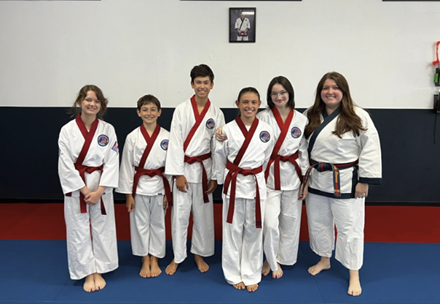
The Woodlands Martial Arts Academy regularly hosts events like Parent’s Night Out, where families can enjoy a night off while students enjoy fun activities at the Dojang. Most recently, they hosted a Spooky Halloween Costume Party, which was a lot of fun for both the staff and students. They also host monthly special classes and activities, such as pumpkin slicing with swords and the Thanksgiving-themed "Turkey Gauntlet" obstacle course. Additionally, for the holidays, they host their annual Black Belt Club Christmas Party. All these events add an extra layer of excitement to the training experience and help build a strong sense of community!
The Woodlands Martial Arts Academy recently hosted its first annual Regional Tournament, known as the Iron Spur Championship. The academy hopes to grow the event from the approximately 50 students who participated this year into a much larger regional tournament in 2026.
Looking Toward the Future
As The Woodlands Martial Arts Academy moves into 2026, it’s preparing for even bigger things. The school is planning to revamp its class schedule to offer more opportunities for adults, and Master Bowman is involved in the planning of the 2026 MGK National Tournament to be held in Houston, Texas. The future looks bright for the academy, as it continues to grow and make an impact on its students and the martial arts community.
On a personal note, SBN Bowman is now engaged to her fiancé, Ty Turner, and the couple plans to marry in October. She shared this with her students, and they were so excited, but they thought it would be very strange to call her SBN Turner instead of SBN Bowman!
Conclusion
The Woodlands Martial Arts Academy is more than just a martial arts school; it’s a place where students learn the values of integrity, respect, and perseverance. With a strong foundation in Tang Soo Do and a commitment to fostering personal growth and community, the academy is poised for continued success. As it celebrates its first few years of operation, it’s clear that SBN Emily Bowman and her team are creating a legacy that will inspire martial artists for years to come.

When asked, what makes your studio stand out from others? SBN Bowman answered with ‘Our school stands out because of the family-oriented culture we create. Students of all ages and backgrounds are welcome with open arms. We really want everyone who steps through the front doors of our Dojang to feel like family. Our students are expected to have a martial arts attitude on and off the mat. No matter how long our students train with us, the thing that we like to think sets us apart is the time we spend with those students and try to leave a lasting impact on them because they definitely leave one on us!’
Additional information about The Woodlands Martial Arts Academy can be found on the website at www.twmaa.com . You can contact them by phone at 281-292-0225 / 832-445-9678 or email at twmartialartsacademy@gmail.com.
Many Voices, One Art
Our newsletter is strengthened by the voices of our members. By sharing your thoughts, stories, and lessons, you help preserve our traditions and inspire others on their Tang Soo Do journey. If you enjoy writing and have something meaningful to share with the Tang Soo Do Mi Guk Kwan community, please contact Virginia Folger at Virginia.Middleburymaa@gmail.com to be featured in a future edition.


Comments